Ad

Ad

Progress for group 0 ad
Rahel Solomon
Addis Ababa, Ethiopia
Amein Eskinder remembers the time when his grandmother used to be sick. She needed medication weekly, and he went out every Friday to find them. Sometimes his search for medication required him to visit every pharmacy in Jijiga, even traveling as far as the border town of Wechale.
On his way, he thinks about platforms such as Amazon, the American multinational technology company focusing on e-commerce.
He also saw how high and synchronized the prices of products in Addis Ababa were. While abroad, there is a variety of pricing in the same marketplace.
“The Ethiopian market is basically centralized and run almost like a monopoly market,” says Amein.
While attending his studies at Jijiga University, Somali Regional State, he dwelled on how such problems could be solved through a B2B (Business-to-Business) platform. Business to business is a type of commerce transaction that exists between businesses, such as those involving a manufacturer and wholesaler or retailer.
His concept design for the platform won him an award in 2018 at “Solve It,” a nationwide innovation competition for Ethiopian youth by iCog Labs, an Ethiopian Artificial Intelligence (AI) company. He was one of the 34 finalists in the nationwide competition.
After graduation, Amein came to the capital, where he was employed as a full-stack software developer. But Amein was also working on his startup at the same time. Formalizing his idea, he returned to the Somali region to test his hypothesis.
Amein selected the Somali region because he believed an e-commerce platform in the region would be quickly adopted.
“Most of the country’s mobile money traffic comes from the Somali region. HelloCash was first introduced there six years ago, while Telebirr is just over a year old. The society has high-tech adoption,” Amein told Shega.
At first, the name of the platform was Jijiga Online. But it was later changed to Taywan as Amein had nationwide visions for his startup. Taywan was perfect as the name is used to describe marketplaces across different cities in Ethiopia.
In addition, Taywan also started as a B2C (Business-to-Consumer) business but pivoted to B2B around one year ago due to the low purchasing power of individuals in Ethiopia. The low frequency of purchases couldn’t bring the desired profit margin for Taywan.
Taywan Store Inc. is a B2B e-commerce supply chain and embedded finance that offers a range of consumer goods and financing for small retailers.
Currently operational in Jijiga, Harari, and Dire Dawa, Taywan is a hybrid e-commerce platform that powers trade and restocking for merchants, retailers, and kiosks. Taywan Store offers a 360° solution that enables factory-to-retail distribution, including financing for MSMEs.
According to Amein, Taywan has four major goals: to create a free market that boosts MSME’s growth and sustains a competitive environment for manufacturers and suppliers; to eliminate artificial inflation and create a strong linkage between stakeholders; to enable data-driven-decision-making to achieve import substitution; and to deliver homemade products to the global market.
The supply chain in the Ethiopian market is broken as it involves many stakeholders. The price of a product increases as it passes through each stakeholder in the supply chain. The chain is also outdated because it is not data-oriented.
Merkato is also very centralized, making it a powerful marketplace in the country. Importers in Merkato face several challenges. The wholesalers do not pay the importers immediately; rather, they pay them later. For the importers who utilize Letters of Credit, the dollar value may change within that period, resulting in a loss.
Amein adds that the market can sometimes also be hostile, bankrupting the importer by attacking him through different vices.
Highly interconnected wholesalers determine the price of products at a desired time and place, causing a ripple effect of a price surge throughout the country within short intervals. This uniformity of pricing in the market creates artificial inflation.
Amein explains the typical supply chain from Merkato to Jijiga.
“When products are imported from abroad, they go to Merkato, then to wholesalers. Bukars [Somali traders], after buying it from wholesalers in Merkato, they distribute it to smaller Bukars in Jijiga, who sell it to retailers,” Amein explains.
“The connection these people have is limited by finance and data. There is no product demand and supply data, and Taywan is here to bridge that gap,” added Amein.
Taywan is an offline service that mimics an online one. Merchants first get profiled and submit their photos, identification cards, and business licenses. The location of their shop is also registered through geolocation, and the merchant is then given a customer identification card (CID).
Merchants are connected to Taywan via a call center. When they call the center, the merchant orders the product using his CID. From the first day on, Taywan records all the transactions and determines the creditworthiness of the merchant.
A merchant can order a product for restocking by calling the dispatch center. Taywan delivers the products within 2 hours of the call, free of charge. Currently, Taywan uses rental logistics to deliver the products.
Taywan buys fast-moving consumer goods, products that are sold quickly and at a relatively low cost, in large quantities from the importers at a discount and then distributes them to small retailers. According to Amein, four participants in the supply chain are eliminated in this process, lowering the price of the products. Taywan also fills the data gap because it is data-oriented.
Taywan’s portal provides real-time integration between back office inventory systems and the stock held by third-party logistics providers and distributor warehouses.
The prices for the products will be set according to the prices of the products Taywan received from the importers. Making the price difference between similar products creates price competition.
Taywan has agents in different Ethiopian cities where they operate who are trained and given duties on behalf of Taywan in their respective cities. The agents are assigned a certain number of merchants, and the merchants’ orders go to the agents. These agents distribute the items as well as follow up on the merchants’ credit.
There are currently 2500 merchants on the platform and a pending list of 900. Amein says this was done through just word-to-mouth marketing alone. They have not yet enlisted importers as they buy after determining the demand needs of merchants and due to capital constraints. But they have five expressions of interest from importers and four manufacturers are already working with them.
Taywan has manufacturing aggregation: meaning manufacturers don’t need to worry about marketing. Taywan takes over distribution for manufacturers. Additionally, Taywan provides a service of import aggregation: they rent out their stores to the importers until distribution.
Last but not least, Taywan also started Asebeza, a service that sells products for household consumption for a lower price with delivery to the customer.
“In Ethiopia, the number of people who have taken loans from banks is estimated to be 350,000, compared to the 115 million meager population,” said Amein.
Many merchants in Ethiopia are underbanked. Even if they pass the collateral requirement, they must wait a minimum of 5–6 months. In addition, these merchants, especially in regional areas, don’t have smartphones and the internet, and there is no medium for connection.
However, many merchants have a problem covering their day-to-day living expenses and fear loss because the revenue they get from sales must be used to pay for the next restock.
Taywan plans to avail loans for its merchants. The loan is not given to merchants in cash but enables them to order items from Taywan on credit. Taywan offers a Sharia-compliant loan, meaning interest will not be added when repaid. The merchants only pay a service fee for the loan provided; the service fee doesn’t rise over time, unlike interest.
The merchants must buy products worth at least 5000 birr to get a loan from Taywan. The loan starts from 2000 birr and increases according to the progressive creditworthiness of the merchant. Call center agents will follow up on the sales of merchants at 4-5 day intervals.
With an initial capital of 3 million birr, Taywan has had a transaction volume of over 7.8 million over the past 8–9 months. They want to raise half a million dollars to scale their operations.
They piloted their loan scheme with 100,000 birr using their own money, providing the loan to 23 merchants within two months. Amein told Shega that all the merchants who borrowed the money had returned it. The feedback they are getting from merchants is that the loans are too small to scale their shops. Some also ask them to lend them in cash.
Taywan is currently working with ArifPay to utilize its payment gateway and MPOS services.
“Many digital finance operators are showing interest in working with us,” he added.
The country’s very restrictive financial legal framework, which constrains foreign investors from collecting invested money with profits, remains one of the biggest
Share this post:
Rahel Solomon
At Shega, we do more than tell stories. We help you make an impact. Our platforms, data, and expertise connect brands, organizations, and investors to the audiences and insights that matter.
Reach, engage, and grow with us.
Get in Touch
How to Think about Financial Inclusion in Ethiopia?
17 April 2024
Visa at the Doorsteps of Ethiopia’s Payment Ecosystem
06 September 2023
Latest Stories
22 December 2025
𝗗𝗲𝘀𝗶𝗴𝗻𝗲𝗱 𝗳𝗼𝗿 𝗪𝗵𝗼𝗺? 𝗧𝗵𝗲 𝗠𝗶𝗿𝗮𝗴𝗲 𝗼𝗳 𝗪𝗼𝗺𝗲𝗻-𝗖𝗲𝗻𝘁𝗿𝗶𝗰 𝗗𝗶𝗴𝗶𝘁𝗮𝗹 𝗙𝗶𝗻𝗮𝗻𝗰𝗲 𝗶𝗻 𝗘𝘁𝗵𝗶𝗼𝗽𝗶𝗮 QA
By Chilen14 December 2025
From Campus Idea to Satellite TV: Ethiopia Gets Its First Home Shopping Channel QA test
By ChilenLatest Stories
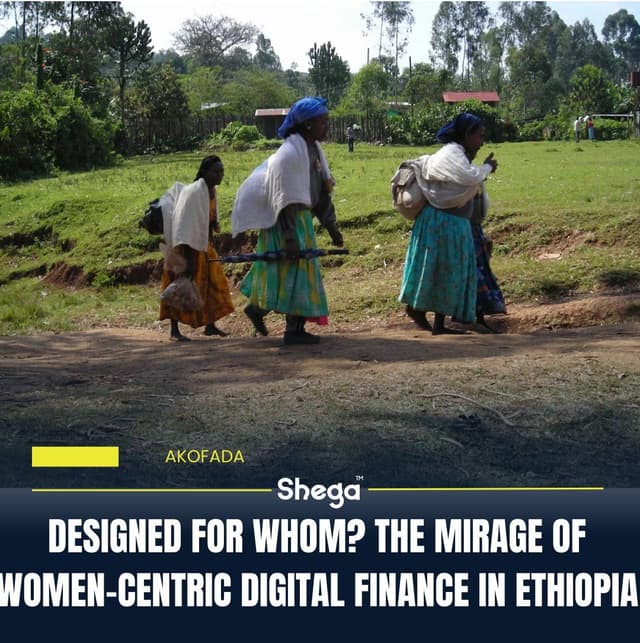
𝗗𝗲𝘀𝗶𝗴𝗻𝗲𝗱 𝗳𝗼𝗿 𝗪𝗵𝗼𝗺? 𝗧𝗵𝗲 𝗠𝗶𝗿𝗮𝗴𝗲 𝗼𝗳 𝗪𝗼𝗺𝗲𝗻-𝗖𝗲𝗻𝘁𝗿𝗶𝗰 𝗗𝗶𝗴𝗶𝘁𝗮𝗹 𝗙𝗶𝗻𝗮𝗻𝗰𝗲 𝗶𝗻 𝗘𝘁𝗵𝗶𝗼𝗽𝗶𝗮 QA
22 December 2025
From Campus Idea to Satellite TV: Ethiopia Gets Its First Home Shopping Channel QA test
14 December 2025

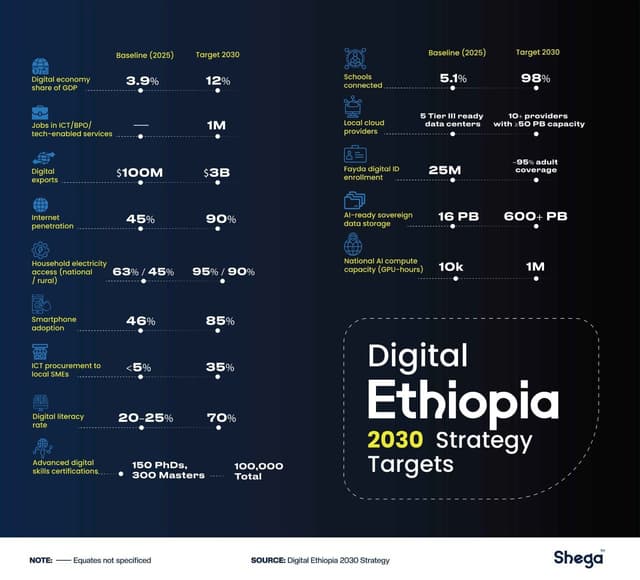
𝗗𝗮𝘁𝗮 𝗦𝗼𝘃𝗲𝗿𝗲𝗶𝗴𝗻𝘁𝘆, 𝗧𝗲𝗰𝗵-𝗦𝗮𝘃𝘃𝘆 𝗖𝗶𝘃𝗶𝗹 𝗦𝗲𝗿𝘃𝗮𝗻𝘁𝘀 & 𝟭 𝗺𝗶𝗹𝗹𝗶𝗼𝗻 𝗜𝗧 𝗷𝗼𝗯𝘀: 𝗨𝗻𝗽𝗮𝗰𝗸𝗶𝗻𝗴 𝗘𝘁𝗵𝗶𝗼𝗽𝗶𝗮’𝘀 𝟮𝟬𝟯𝟬 𝗗𝗶𝗴𝗶𝘁𝗮𝗹 𝗥𝗼𝗮𝗱𝗺𝗮𝗽 on Qa strapi
11 December 2025
How to Think about Financial Inclusion in Ethiopia?
17 April 2024
Visa at the Doorsteps of Ethiopia’s Payment Ecosystem
06 September 2023