Ad

Ad

Progress for group 0 ad

Chilen
Addis Ababa, Ethiopia
Two weeks ago, the Council of Ministers approved the Digital Ethiopia Vision 2030 roadmap, charting a new five-year trajectory for cross-cutting digital transformation. The plan signals a shift from diagnostic ambition toward targeted, institutionally grounded action, now reinforced by clear, measurable targets across the digital economy.
The 2025 strategy emerged as an evaluative response to Ethiopia’s nascent digital landscape. Drawing on Oxford’s Pathways for Prosperity framework, it identified four priority sectors, agriculture, manufacturing, IT-enabled services, and tourism, while cataloguing gaps in infrastructure, enabling systems, and ecosystem capacity. Its approach was iterative: understand the landscape, consult stakeholders, then propose projects.
Five years later, much has changed, and not nearly enough.
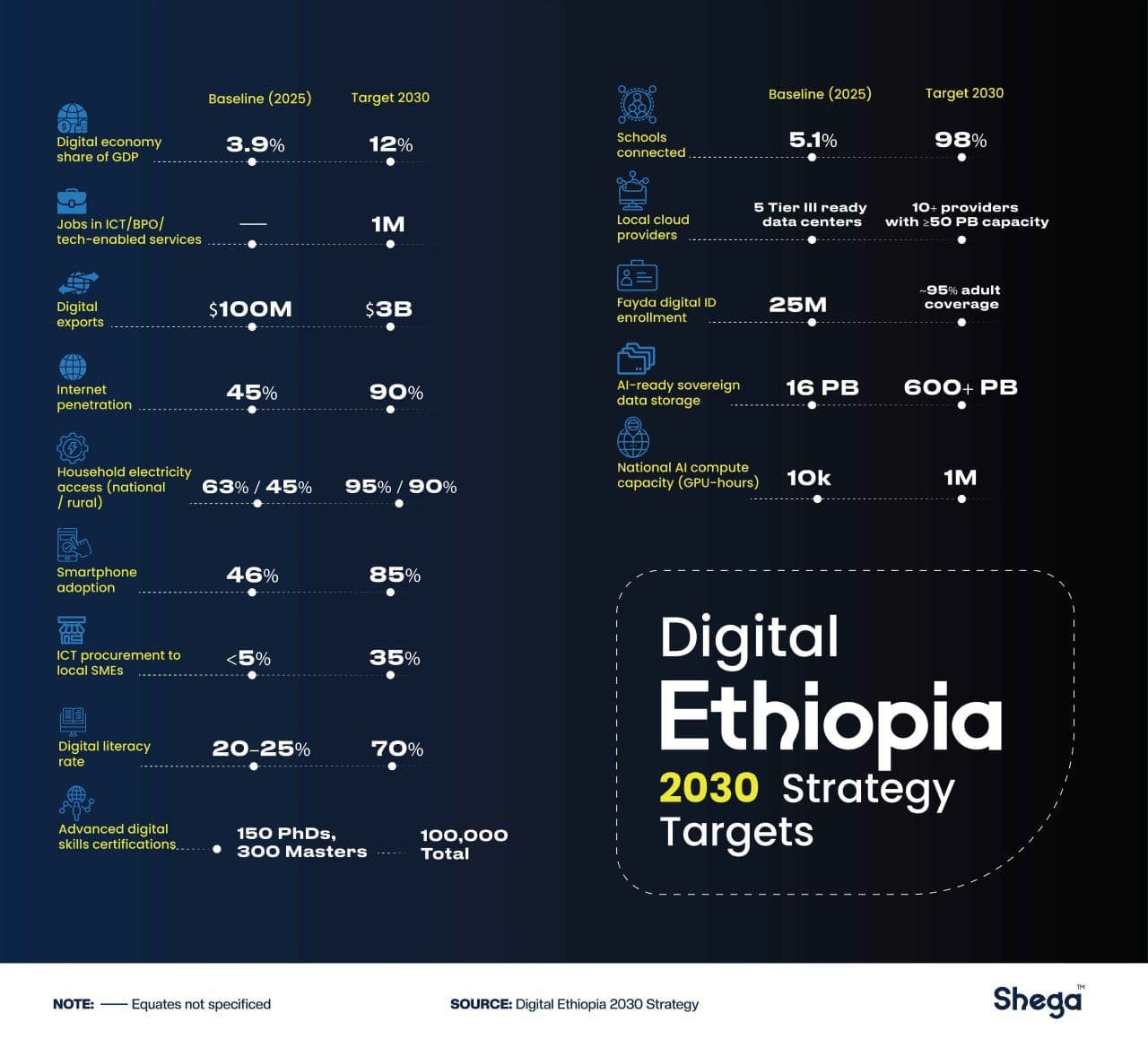
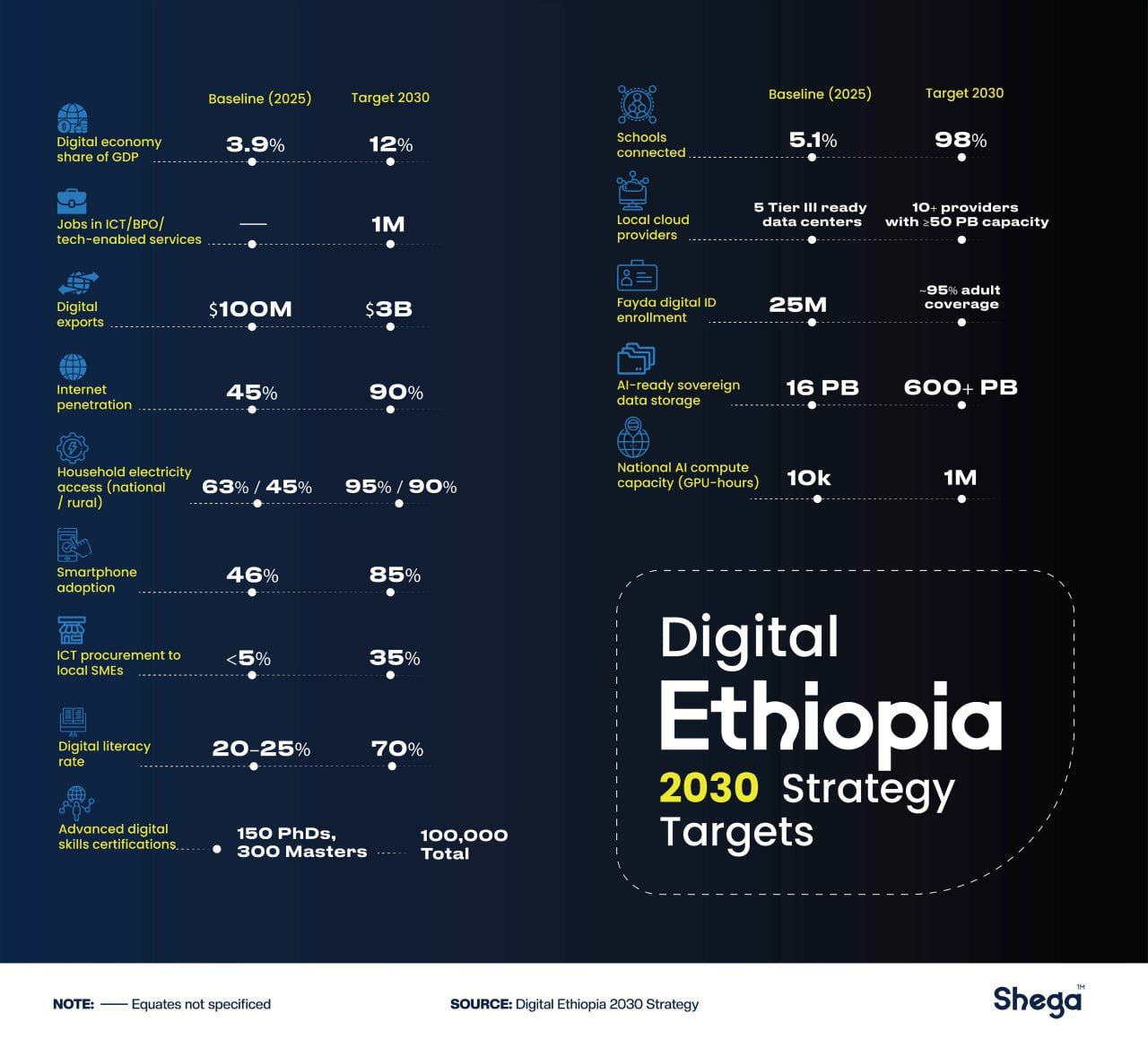
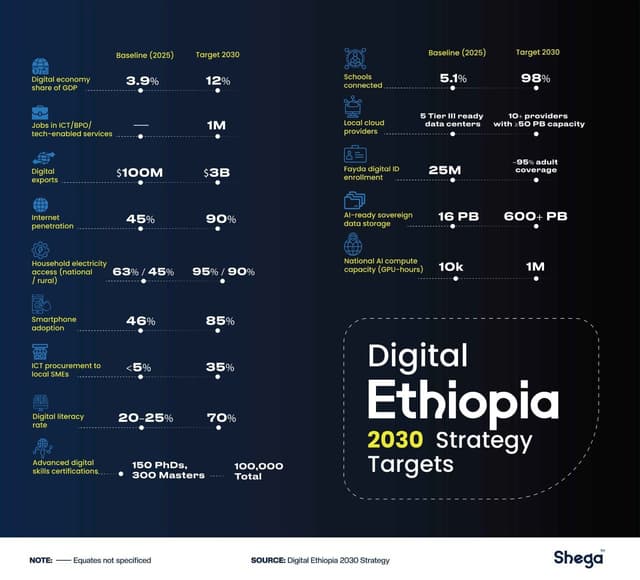
The 2030 framework reads like an implementation manual shaped by experience. It explicitly notes that “earlier modernization efforts have been challenged not in planning, but in execution,” a rare admission in Ethiopian policy. Building on progress, including 63% electricity access, 45% internet penetration, 25 million Fayda digital ID enrollments, and more than 800 digitized government services, the roadmap sets ambitious numeric goals: 60% internet penetration by 2027, 90% by 2030, and 95% household electricity access nationally, 90% in rural areas by 2030.
A notable evolution is the 2030 strategy’s embrace of digital sovereignty. The roadmap prioritizes homegrown solutions, sovereign cloud infrastructure, and data localization. It also integrates Medemer, the philosophical framework of Prime Minister Abiy Ahmed, positioning unity and synergy as guiding principles for governance.
Targets appear to be grounded in pragmatism. Where the prior strategy forecasted 300,000 digital jobs, an ambition that fell short, the 2030 plan lays out a phased path, with 200,000 jobs in ICT, BPO, and tech-enabled services by 2027 and one million by 2030. Digital GDP contribution is projected to rise from 3.9% to 6% by 2027 and 12% by 2030, with digital exports climbing from under USD 100 million today to USD 500 million by 2027 and USD 3 billion by decade’s end. Digital SMEs, currently fewer than 200, are targeted to reach 1,000 by 2027 and 5,000 by 2030.
The 2025 roadmap highlighted governance fragmentation and recommended stronger coordination. In practice, inter-ministerial task forces remained largely conceptual. Transformation has remained elusive. Services weren’t always trusted. Infrastructure wasn’t always ready. Institutional silos persisted.
The 2030 plan looks to address this gap with specificity, evolving the Digital Transformation Council (DTC) into a center of execution, supported by permanent coordination teams, technical advisory committees, performance dashboards, and structured private-sector co-implementation.
A National Data Governance Entity will oversee standards, privacy, sovereignty, and cross-border protocols, enabling integration of Fayda across 80% of services by 2027 and 100% of major Government-to-Citizen (G2C) and (Government-to-Business) G2B services by 2030. The Ministry of Innovation and Technology, once “first among equals,” now co-leads nearly every initiative, sharing responsibilities with specialized institutions such as the Ethiopian AI Institute and the Information Network Security Agency.
Emerging technologies now sit at the core of Ethiopia’s strategy. Where 2025 focused on connectivity and basic digital payments, 2030 mainstreams Industry 5.0 technologies. AI and machine learning are planned for deployment for predictive analytics across sectors, supported by a national compute capacity that expands from 10,000 GPU-hours today to 50,000 by 2027 and one million by 2030. AI-ready sovereign data storage will scale from 16 Petabytes to over 600 by 2030. Blockchain will expand from pilot projects to full national supply-chain traceability. XR technologies will enhance heritage tourism and immersive learning. Quantum computing is prioritized for cybersecurity.
Telecom targets reflect similar ambition, with 4G coverage reaching 99% by 2030, 5G expanding from 26 towns today to 100 towns with 22 advanced use cases, and broadband affordability dropping from over 5% of average monthly income to under 2%. This vision is anchored in a sovereign cloud initiative, mandating green Tier III+ data centers, doubling local cloud providers from five to more than 10 by 2030, and attracting global hyperscalers.
The private sector shifts from a passive “enabled” role to a strategic “co-implementer” is also envisioned. Mechanisms include a Public-Private Digital Forum, fast-track procurement pathways, startup-friendly engagement models, and a state-backed Fund of Funds. Operationalizing the Startup Proclamation introduces licensing, IP protections, and regulatory sandboxes, aligning with sector goals, including BPO revenues of USD 845.7 million by 2030, gaming revenues reaching USD 280 million by 2025 with 24 million mobile gamers, and e-commerce revenues at USD 465 million in 2024. Currently, both the gaming and e-commerce industries are in their infancy levels, with the majority of operators in the latter industry averaging less than $10K in annual sales. Gaming is dominated by casino style offerings by betting companies.
However, the roadmap is not limited to revenue targets in its international ambitions. Unlike the 2025 strategy, which only mentioned AfCFTA compliance, the 2030 plan embeds Ethiopia within AU frameworks for digital transformation, AI, and data policy. The EthioConnect national data exchange platform is designed for interoperability beyond borders, positioning Ethiopia as a potential regional hub. Digital FDI , a term that refers to investment in intangible assets, is planned to grow from under USD 100 million today to USD 500 million by 2027 and USD 1 billion by 2030, while digitally delivered services in total exports are projected to rise from 5% to 20%.
Perhaps the most candid evolution is the roadmap’s acknowledgment that reforms have faltered in execution. The 2030 strategy embeds change management at every level, linking digital KPIs to institutional budgets, appointing Digital Change Leads in all ministries, conducting quarterly DTC reviews supported by public dashboards, and awarding Digital Excellence Awards tied to measurable performance. It also mandates localization of digital services, allowing regional governments to adapt national tools to local languages and cultural contexts.
However, significant questions remain about Ethiopia’s ability to execute this ambitious vision. Internet penetration remains stalled at 45%, cybersecurity maturity is still vulnerable at Tier 3: a minimum standard for many enterprises handling sensitive data, and energy access lags far behind targets, particularly in rural areas. Financing gaps, institutional resistance, and weak monitoring and evaluation systems threaten to undermine even the most sophisticated plans.
The roadmap is impressively detailed, but detail alone does not guarantee results. Past efforts have repeatedly faltered not from lack of vision, but from execution challenges, and many of the 2030 targets, such as one million ICT and tech-enabled jobs, 98% school connectivity, and dramatic leaps in digital exports, will require unprecedented coordination, political will, and sustained investment. Without robust mechanisms to translate ambition into action, Ethiopia risks another five-year plan that is bold on paper but limited in impact.
But for now, the plan is approved, the dashboard is active, and the countdown, once again, has begun.
Quick Links
#fintechShare this post:

Chilen
Chilenew is well Experienced QA Engineer
At Shega, we do more than tell stories. We help you make an impact. Our platforms, data, and expertise connect brands, organizations, and investors to the audiences and insights that matter.
Reach, engage, and grow with us.
Get in Touch
Addis Software, Building High-End Products for International Market
09 September 2021
Teraki Launches its Audio Content Streaming Platform
30 June 2021
Latest Stories
22 December 2025
𝗗𝗲𝘀𝗶𝗴𝗻𝗲𝗱 𝗳𝗼𝗿 𝗪𝗵𝗼𝗺? 𝗧𝗵𝗲 𝗠𝗶𝗿𝗮𝗴𝗲 𝗼𝗳 𝗪𝗼𝗺𝗲𝗻-𝗖𝗲𝗻𝘁𝗿𝗶𝗰 𝗗𝗶𝗴𝗶𝘁𝗮𝗹 𝗙𝗶𝗻𝗮𝗻𝗰𝗲 𝗶𝗻 𝗘𝘁𝗵𝗶𝗼𝗽𝗶𝗮 QA
By Chilen14 December 2025
From Campus Idea to Satellite TV: Ethiopia Gets Its First Home Shopping Channel QA test
By ChilenLatest Stories
𝗗𝗲𝘀𝗶𝗴𝗻𝗲𝗱 𝗳𝗼𝗿 𝗪𝗵𝗼𝗺? 𝗧𝗵𝗲 𝗠𝗶𝗿𝗮𝗴𝗲 𝗼𝗳 𝗪𝗼𝗺𝗲𝗻-𝗖𝗲𝗻𝘁𝗿𝗶𝗰 𝗗𝗶𝗴𝗶𝘁𝗮𝗹 𝗙𝗶𝗻𝗮𝗻𝗰𝗲 𝗶𝗻 𝗘𝘁𝗵𝗶𝗼𝗽𝗶𝗮 QA
22 December 2025
From Campus Idea to Satellite TV: Ethiopia Gets Its First Home Shopping Channel QA test
14 December 2025

𝗗𝗮𝘁𝗮 𝗦𝗼𝘃𝗲𝗿𝗲𝗶𝗴𝗻𝘁𝘆, 𝗧𝗲𝗰𝗵-𝗦𝗮𝘃𝘃𝘆 𝗖𝗶𝘃𝗶𝗹 𝗦𝗲𝗿𝘃𝗮𝗻𝘁𝘀 & 𝟭 𝗺𝗶𝗹𝗹𝗶𝗼𝗻 𝗜𝗧 𝗷𝗼𝗯𝘀: 𝗨𝗻𝗽𝗮𝗰𝗸𝗶𝗻𝗴 𝗘𝘁𝗵𝗶𝗼𝗽𝗶𝗮’𝘀 𝟮𝟬𝟯𝟬 𝗗𝗶𝗴𝗶𝘁𝗮𝗹 𝗥𝗼𝗮𝗱𝗺𝗮𝗽 on Qa strapi
11 December 2025
Addis Software, Building High-End Products for International Market
09 September 2021
Teraki Launches its Audio Content Streaming Platform
30 June 2021