Ad

Ad

Progress for group 0 ad

Kaleab Girma
Addis Ababa, Ethiopia
Dodai, an Addis Ababa-based electric vehicle (EV) startup, has secured $4 million in its Series A round, marking one of the largest amounts raised by startups in Ethiopia in a single round.
This latest equity funding brings Dodai’s total raised capital to $6.2 million since its inception, with the startup aiming to secure an additional $2 million in its Series A round.
The investors in this round include Nissay Capital, the corporate venture capital arm of Nissay, a $500 billion asset insurance and asset management company, making its first investment in Africa, and Musashi Seimitsu, a $3 billion revenue automotive parts supplier.
Inclusion Japan (ICJ), a Tokyo-based venture with a $100 million fund, also joined as a returning investor, having previously invested in Ethiopian startups such as Gebeya, GoodayOn, and Addis Software.
“I have been visiting Ethiopia every three months since 2022, not only to support startups but also to continue to invest in surrounding startups around Dodai,” shared Yasuhiro Yoshizawa, co-founder and general partner of Inclusion Japan, in a written statement to Shega.
“I truly feel that Dodai’s development is strongly leading the entire Ethiopian startup ecosystem. With the arrival of new, powerful investors from Japan this time, I am thrilled about the imminent exponential growth of the business,” he added.
In an interview with Shega, Yuma Sasaki, the founder and CEO of Dodai, stated that 80 percent of the funding will be allocated to importing electric motorbike parts and lithium batteries, 15 percent for general administrative expenses, and 5 percent for software development for battery swapping, slated for launch in Q4 of 2024.
Meaning “foundation” in Japanese, Dodai was founded in Ethiopia in 2023. Yuma established the company after his venture in Djibouti, where he provided a pay-as-you-go payment system to equip low-income families with electricity.
According to Yuma, his venture in Djibouti didn’t go well. Using Djibouti as a base, Yuma prepared for the launch of urban E-mobility in Ethiopia, paring with Ethiopian serial investor Addis Alemayehu as his mentor and advisor.
Sharing his motivation behind Dodai, Yuma stated, “I decided to focus on solving fundamental problems that contribute to improving people’s lives on a large scale. When researching areas such as electricity, fintech, real estate, and mobility, all essential aspects of our lives, I became convinced that e-mobility makes the most sense. Transportation is a significant challenge for the majority of people in Addis Ababa. One e-motorbike equals one job, and it has the potential to reduce government spending on fuel while also presenting an opportunity for foreign investors.”
Yuma, who graduated from the University of Tokyo after “a failed music career”, has several years of experience working with startups in both Africa and Japan. He also led a commercial team at Uber and successfully launched a sharing e-scooter service in Japan.
His latest move aims to facilitate access to simple and affordable mobility in Ethiopia, where the motorization rate is only 3–4 percent. Dodai’s entry into Ethiopia also coincides with the nation’s efforts to accelerate the transition to electric mobility amidst a global fuel price hike.
Ethiopia spent $6 billion on fuel imports in 2023, over half of which went to fueling vehicles, according to the Ethiopian Ministry of Transport and Logistics. As part of its 10-Year Perspective Development Plan from 2021 to 2030, the Ethiopian government plans to import 4,800 electric buses and 148,000 electric automobiles. The government has also allowed duty-free importation of EV parts to promote EV use and knowledge transfer.
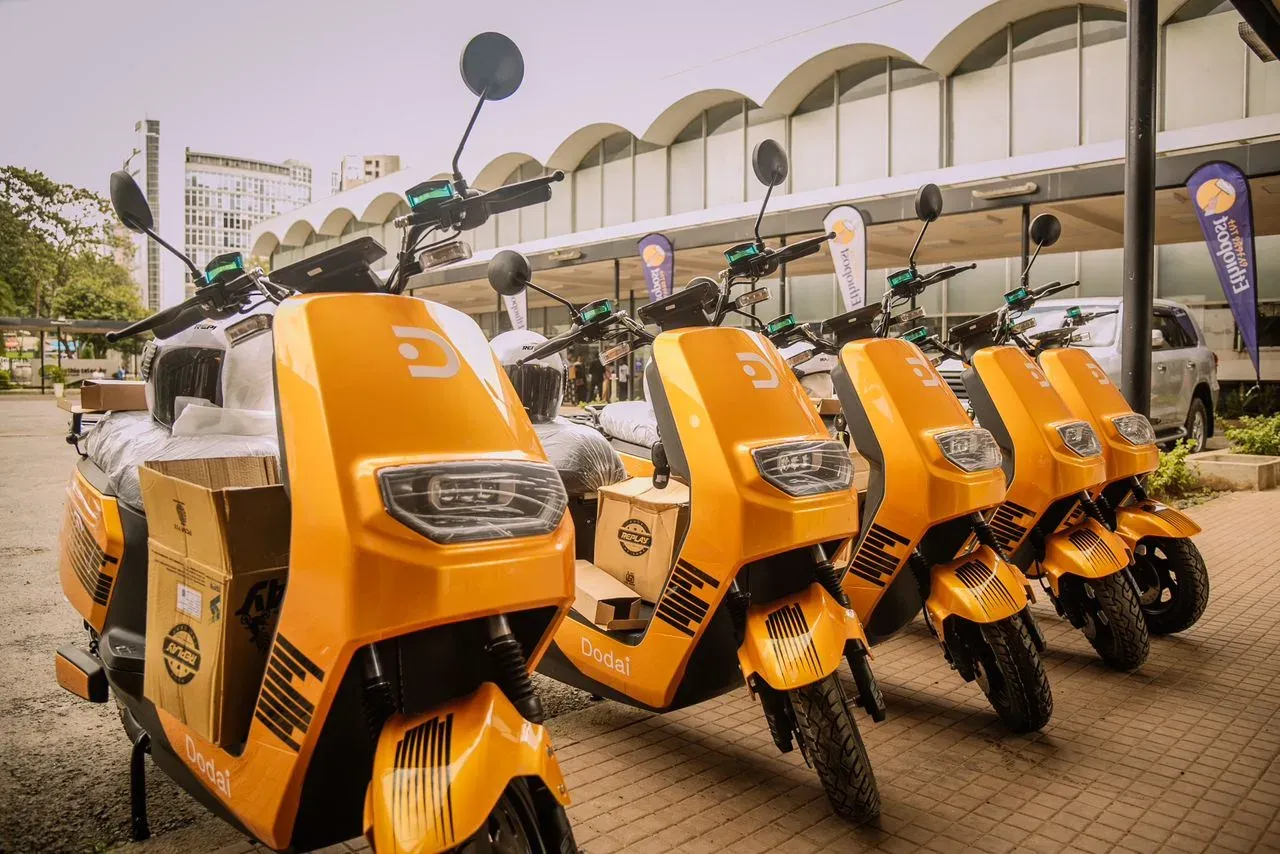
With items imported from abroad, Dodai assembles electric bikes capable of traveling up to 150 km per charge, utilizing lithium batteries that have a lifespan of up to eight years. The bikes have a top speed of 60 km/hour.
Initially, the company offered its e-bikes at 200,000 birr, significantly higher than market prices for other e-bikes. Prices have since dropped to a discounted 150,000 birr.
“We are using expensive but quality lithium batteries with 1500 charging cycles. On top of that, we are also working on a battery swapping model, which is increasingly common in populous urban areas such as Taipei, Delhi, Kigali, Nairobi, and Singapore,” said Yuma.
Currently, the company has around 20 employees and a production capacity of 200 units per month. The startup is planning to increase its capacity to 1500 units per month.
Related- Little Ethiopia Shifts Gear, Introduces Electric Bike-Powered Delivery Service
Companies engaged in the delivery sector, such as BeU, Rungooo, and EthioPost, the national postal carrier, are Dodai’s biggest customers. However, according to Yuma, sales would have been much higher if not for regulatory restrictions.
On August 28, 2023, the Addis Ababa Transport Bureau issued a notice implementing an existing, yet previously unenforced, rule on e-bikes and their owners. According to the regulation, any vehicle with a top speed exceeding 20 kilometers per hour must now acquire a license plate and insurance, and drivers must possess a valid license.
However, drivers of EV bikes who approached the Bureau to secure the plates were told that there is no legal framework in place for the registration of the motors. As a result, the owners were left stranded and could no longer use their vehicles.
The issue remains unresolved, even after five months. The only EV bikes currently seen on the streets of Addis Ababa are those owned by companies, as they can use the code 3 plate designated for businesses.
Shega was unable to reach the Addis Ababa Transport Bureau before the publication of this article. However, one official in one of the capital’s transport regulation offices, who preferred not to disclose his name as he is not authorized to speak on the matter, informed Shega that the restriction is not specific to EV motors but applies to all motorcycles for private use.
“Since 2020, the city has not been issuing priva
Share this post:
Kaleab Girma
At Shega, we do more than tell stories. We help you make an impact. Our platforms, data, and expertise connect brands, organizations, and investors to the audiences and insights that matter.
Reach, engage, and grow with us.
Get in Touch
Electric Charging Stations in Addis Ababa
25 May 2024
Affordable Electric Vehicles in Addis Ababa
05 April 2024

Addis Ababa to Implement Full Ban on Fuel Motorcycles
03 April 2024
Latest Stories
22 December 2025
𝗗𝗲𝘀𝗶𝗴𝗻𝗲𝗱 𝗳𝗼𝗿 𝗪𝗵𝗼𝗺? 𝗧𝗵𝗲 𝗠𝗶𝗿𝗮𝗴𝗲 𝗼𝗳 𝗪𝗼𝗺𝗲𝗻-𝗖𝗲𝗻𝘁𝗿𝗶𝗰 𝗗𝗶𝗴𝗶𝘁𝗮𝗹 𝗙𝗶𝗻𝗮𝗻𝗰𝗲 𝗶𝗻 𝗘𝘁𝗵𝗶𝗼𝗽𝗶𝗮 QA
By Chilen14 December 2025
From Campus Idea to Satellite TV: Ethiopia Gets Its First Home Shopping Channel QA test
By ChilenLatest Stories
𝗗𝗲𝘀𝗶𝗴𝗻𝗲𝗱 𝗳𝗼𝗿 𝗪𝗵𝗼𝗺? 𝗧𝗵𝗲 𝗠𝗶𝗿𝗮𝗴𝗲 𝗼𝗳 𝗪𝗼𝗺𝗲𝗻-𝗖𝗲𝗻𝘁𝗿𝗶𝗰 𝗗𝗶𝗴𝗶𝘁𝗮𝗹 𝗙𝗶𝗻𝗮𝗻𝗰𝗲 𝗶𝗻 𝗘𝘁𝗵𝗶𝗼𝗽𝗶𝗮 QA
22 December 2025

From Campus Idea to Satellite TV: Ethiopia Gets Its First Home Shopping Channel QA test
14 December 2025

𝗗𝗮𝘁𝗮 𝗦𝗼𝘃𝗲𝗿𝗲𝗶𝗴𝗻𝘁𝘆, 𝗧𝗲𝗰𝗵-𝗦𝗮𝘃𝘃𝘆 𝗖𝗶𝘃𝗶𝗹 𝗦𝗲𝗿𝘃𝗮𝗻𝘁𝘀 & 𝟭 𝗺𝗶𝗹𝗹𝗶𝗼𝗻 𝗜𝗧 𝗷𝗼𝗯𝘀: 𝗨𝗻𝗽𝗮𝗰𝗸𝗶𝗻𝗴 𝗘𝘁𝗵𝗶𝗼𝗽𝗶𝗮’𝘀 𝟮𝟬𝟯𝟬 𝗗𝗶𝗴𝗶𝘁𝗮𝗹 𝗥𝗼𝗮𝗱𝗺𝗮𝗽 on Qa strapi
11 December 2025
Electric Charging Stations in Addis Ababa
25 May 2024
Affordable Electric Vehicles in Addis Ababa
05 April 2024
Addis Ababa to Implement Full Ban on Fuel Motorcycles
03 April 2024